Food scarcity and rationing in the Annex
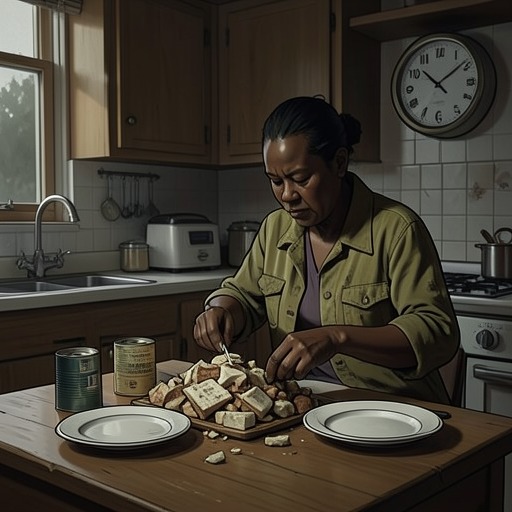
Diary of Anne FrankFood scarcity and rationing in the Annex were not a single crisis but a changing condition that governed the residents’ supplies, routines, labor, and relations with one another. The diary records both the practical arithmetic of survival—ration books, stored beans, vegetable cans, and carefully divided portions—and the intimate costs of that arithmetic: resentment over fairness, meals made from deteriorating food, and a household increasingly worn down by scarcity.
Supplies, Substitutions, and Hidden Reserves
Early on, bread still arrived daily through a baker who was a friend of Mr. Kleiman, but the Annex had less than the family had eaten at home. Ration books purchased on the black market supplemented official supplies, at a price that rose from 27 to 33 guilders. The books were sheets of printed paper, yet their practical value lay in what they could secure. Food thus moved through overlapping channels: deliveries, rationing, and illicit purchase, with the cost of access increasing even as the supply itself remained uncertain.
The residents also tried to build a reserve that could outlast immediate shortages. Alongside a store of one hundred cans, they bought three hundred pounds of beans, intended not only for the hidden group but also for the office staff. The sacks were first hung on hooks in the hallway just inside the concealed entrance, but some seams split under their weight, prompting a move to the attic. Peter carried five sacks upstairs intact. The sixth, holding roughly fifty pounds, broke on the stairs, scattering beans in a noisy cascade that frightened those downstairs into thinking the building was collapsing. The mishap turned stored food into a comic image of abundance and disorder: beans rolled into corners and crevices, and the residents kept gathering them to offer handfuls to Mrs. van Pels. The stockpile promised security, but even its storage required labor and created risks.
By the time the residents considered how to respond to the danger outside, their provisions had become an explicit inventory and a plan for endurance. They proposed bringing Mr. Kleiman and his family into the Annex, finding wood shavings for floor bedding, and asking Miep and Mr. Kleiman to bring blankets. For food, they discussed ordering more cereal grains to supplement the sixty-five pounds already on hand; Jan might find additional beans. They also counted about sixty-five pounds of beans, ten pounds of split peas, and fifty cans of vegetables. These figures make the effort to prepare tangible: security depended not only on concealment but on estimating how long stored staples might sustain more people.
Allocation and the Politics of the Table
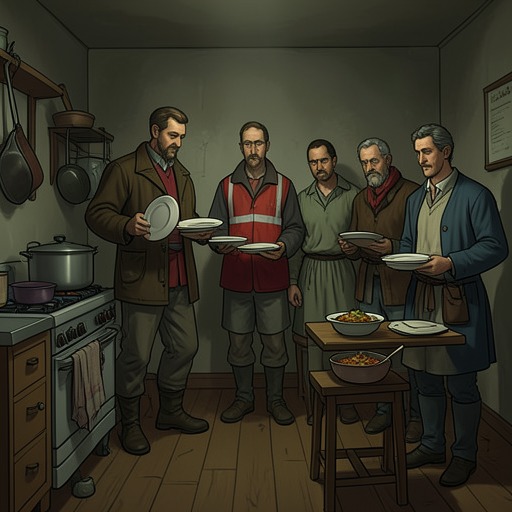
Within the Annex, scarcity became a question of distribution as well as quantity. When butter and margarine were divided, each person was meant to receive a portion on their own plate. Anne judged the arrangement unfair: the van Pels, who prepared breakfast for everyone, gave themselves one and a half times as much as they gave the others. Her parents were reluctant to risk an argument, while Anne believed the imbalance should be challenged. A rule designed to make portions visible therefore exposed the unequal power and competing claims that rationing could not settle.
The same conflict recurred as the residents tried to divide other foods. Mrs. van Pels proposed frying fewer potatoes in the morning and saving some for later, but Anne’s mother, Dr. Dussel, and the others objected; potatoes, fats, and oils became further subjects of dispute. For months, meat had been divided so that the van Pels received the fatty portions and the Franks the lean ones; the groups differed over soup, peeled and unpeeled potatoes, extras, and eventually fried potatoes as well. Anne’s exasperated wish that they could divide up completely captures the paradox of rationing in close quarters: subdivision might appear to promise fairness, yet every new boundary made the separation between the households more explicit.
The diary also sets material deprivation beside an earlier life of comfort. Anne imagines that after normal life returns, she may wonder how people who had lived comfortably could have sunk so low in their manners and circumstances. An oilcloth table covering, too worn to be spotless, and a dishcloth riddled with holes make cleaning nearly futile. The same conditions reach into clothing: Father’s trousers and tie are frayed, Mother’s corset has snapped, and Margot’s bra is too small. The passage does not treat hunger as an isolated inconvenience; worn possessions, limited washing, and inadequate clothing belong to the same narrowing world in which ordinary standards of care become harder to maintain.
Work, Theft, and the Shrinking Food Supply
Food provision also demanded work. When Mr. Kugler could not find someone else to fill packets of powdered gravy, the residents took on the job because doing it themselves cost less. The product belonged to Gies & Co.; the task, which Anne compared to prison labor, was tedious enough to make them dizzy and giggly. The episode joins forced inactivity and economic necessity in an awkward domestic routine: the hidden residents supplied labor to help keep the business going, while the savings mattered to their own survival.
A break-in made the fragility of that survival concrete. After Peter found the warehouse and street doors open, the residents followed their security instructions: they did not wash or run water, stayed quiet, dressed by eight, and avoided using the bathroom. The burglars had forced their way through the outside and warehouse doors, then reached the next floor when they found little worth taking. They stole two cashboxes containing forty guilders, blank checkbooks, and coupons for 330 pounds of sugar—the Annex’s entire allotment. Replacing the coupons would not be easy. The incident therefore threatened more than money: sugar was a large, specific part of the food supply, and its loss came through a breach in the very building that sheltered the residents.
By a later crisis, the residents’ five black-market ration books no longer came with coupons, fats, or oils. Their food-coupon suppliers had been arrested, and because Miep and Mr. Kleiman were ill, Bep could not manage the shopping. The interruption in supply connected outside danger directly to the kitchen: the people who secured food were vulnerable, and their absence left the group with fewer ways to acquire it. With no fat, butter, or margarine expected from the following day, fried potatoes at breakfast—previously used to save bread—had to give way to hot cereal.
Deterioration, Disgust, and Domestic Strain
The meals described in this later period register scarcity through their substitutions and smells. Lunch consisted of mashed potatoes and pickled kale; Anne pressed a handkerchief, sprinkled with fragrant prewar perfume, to her nose and mouth while sitting at the van Pels’ oilcloth-covered table. The household kitchen smelled, she wrote, like spoiled plums, rotten eggs, and brine. Potatoes had developed such strange diseases that roughly one bucket in two ended up discarded, and the residents tried to identify those imagined ailments as cancer, smallpox, and measles. Humor survives in the diagnosis game, but it cannot disguise the waste: even a basic staple was increasingly likely to be unusable.
Food trouble amplified other tensions rather than standing apart from them. Anne says the food would matter less if life were more pleasant, then identifies the tedious existence as a cause of growing disagreeableness. Mrs. van Pels complained that cooking without oil was impossible, that the smells made her sick, and that her effort earned ingratitude and rude remarks; she feared starvation and snapped at people when in a bad mood. Mr. van Pels described smoking as a way to make the food, political situation, and household moods seem less unbearable, while lack of tobacco, his need for meat, and dissatisfaction could lead toward a quarrel. The diary gives these complaints their separate voices, showing how the same shortages were experienced through different needs, habits, and grievances.
Scarcity also marked a broader gap between the hidden residents and the outside world. When Jan, Mr. Kugler, and Mr. Kleiman reported prices, the figures sounded almost unreal from inside the Annex: half a pound of tea cost 350 guilders, coffee 80, butter 35 per pound, and an egg 1.45 guilders. Black-market exchange permeated ordinary errands, with a bakery delivery boy offering darning thread, a milkman able to obtain ration books, and an undertaker delivering cheese. Anne notes that people were trying to get food into their stomachs while salaries remained frozen, and that theft and other crimes had become daily occurrences. The Annex’s food problem thus belonged to a society-wide economy of shortage and illicit exchange, even as the residents experienced it through a much narrower and more precarious set of suppliers.
Physical Infrastructure and the Limits of Endurance
The conditions of survival extended beyond food itself to the water and sanitation needed to prepare and dispose of it. When the drains clogged again, only a trickle of water could be run, the toilet could not be flushed, and a toilet brush had to serve in place of flushing. Dirty water accumulated in a large earthenware jar. The residents could manage for the day, but repair depended on a plumber who might not be able to fix the problem alone; the Sanitation Department could not come until Tuesday. In the same entry, Miep sent raisin bread marked with a greeting for Pentecost. The bread was a practical gift, but its cheerful message collided with the residents’ immediate reality, their moods and worries far removed from happiness.
Across these episodes, the diary makes rationing legible through particular quantities, objects, and repeated decisions: three hundred pounds of beans moved to the attic, 330 pounds of sugar coupons stolen, butter and margarine measured onto individual plates, and fried potatoes replaced by hot cereal when fats ran out. Such details show how occupation-era scarcity entered the Annex not as an abstraction but as labor, calculation, compromised meals, and arguments over who deserved what. Stored food could be lost, suppliers could be arrested or become ill, and even a carefully divided portion could become a source of resentment. The residents’ struggle to eat therefore records both their resourcefulness and the pressure that prolonged deprivation placed on their shared life.